

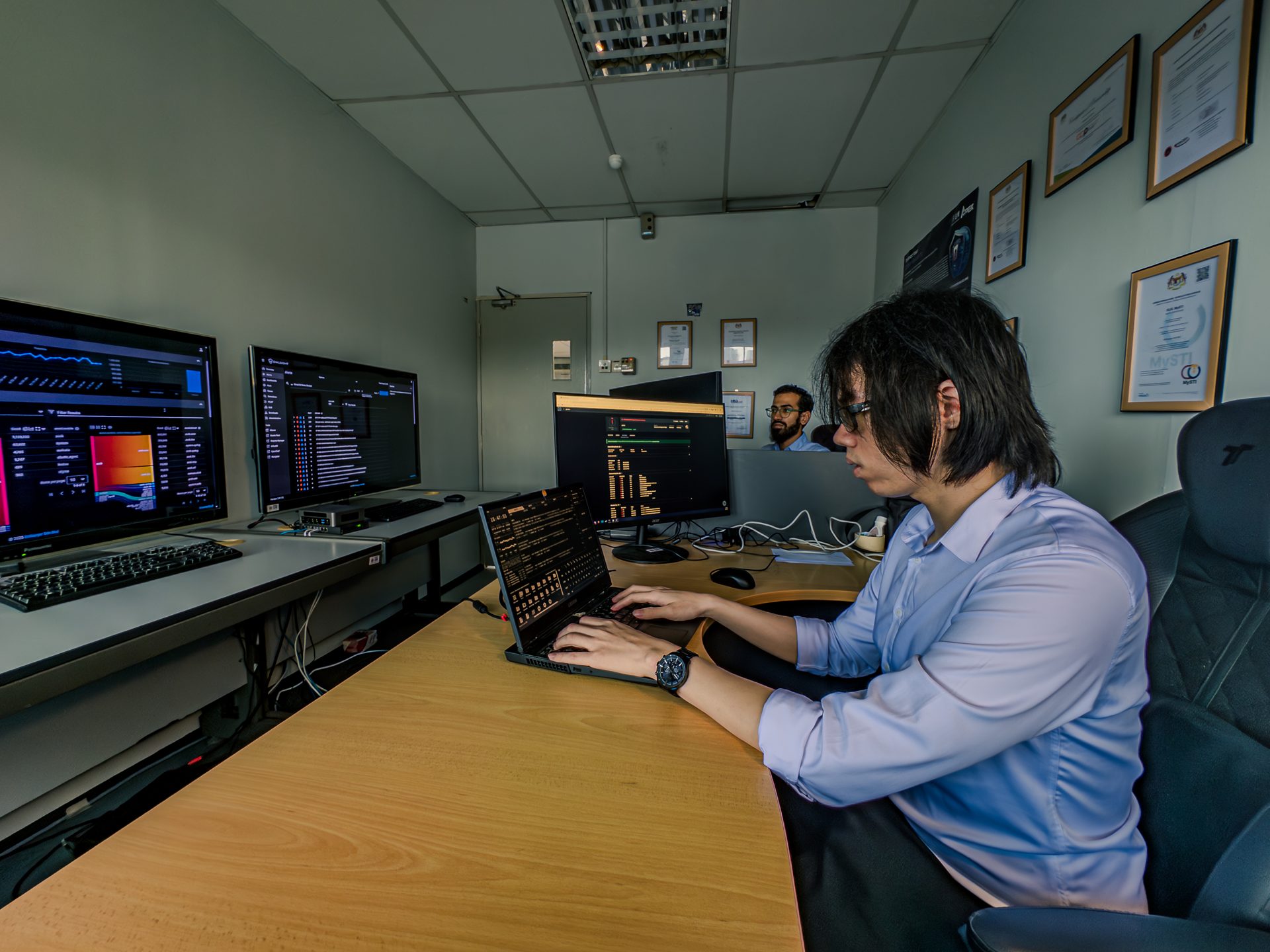
When most small and medium enterprises (SMEs) evaluate their cybersecurity posture, they hit an immediate roadblock. Traditional security solutions are built for large organisations with deep pockets, complex IT structures and dedicated Security Operations Centre (SOC) teams. For an SME with limited staff and a modest budget, enterprise options such as full-scale Endpoint Detection and Response (EDR) or Security Information and Event Management (SIEM) systems are often out of reach.
This leaves a dangerous gap. Attackers know smaller businesses are softer targets and easy entry points into larger supply chains.
FalconSight addresses this gap by moving the defence to where threats start: the Domain Name System (DNS) layer.
Why DNS-based security matters for SMEs
Every online action, whether opening an email link, visiting a website or connecting software to a server, relies on DNS. Before a device connects to an external destination, it sends a DNS query to turn the domain name into an IP address.
FalconSight intercepts network activity at this moment. By inspecting and filtering DNS requests at the network level, it stops threats before malicious files reach a workstation or server.
This approach has several operational advantages:
- Early-stage prevention: blocks phishing domains, ransomware callback channels and malicious sites before a payload is delivered.
- Zero endpoint friction: protects devices across the network without heavy client software on every laptop, phone or desktop.
- Network-wide coverage: secures everything on the local network, including IoT hardware, smart office equipment and guest devices that typically bypass endpoint software.
Core features of FalconSight
FalconSight provides early threat detection without the maintenance burden of enterprise security platforms. It combines network-level interception, a lightweight architecture and automated threat intelligence in a single package.
1. Real-time DNS monitoring and pattern tracking
FalconSight continuously monitors outgoing DNS requests from devices across the network. It inspects connection patterns to identify suspicious domain resolutions, unusual traffic spikes and possible command-and-control (C2) communication from infected devices trying to call home.
2. Instant threat blocking
When a user clicks a malicious link in a phishing email, or an application tries to reach a known harmful domain, FalconSight blocks the query in real time. Dropping the connection at the DNS layer cuts off malware execution paths and credential-harvesting attempts.
3. Passive threat intelligence collection
Alongside active blocking, FalconSight passively gathers local network telemetry. It correlates internal network behaviour with external threat intelligence feeds, giving SMEs local visibility into risks without sending sensitive internal data outside their perimeter.
4. Flexible, plug-and-play deployment
Traditional network security often needs extensive network re-engineering. FalconSight is built for quick setup: it can be deployed as a plug-and-play hardware device or as a virtual appliance inside an existing network, with minimal configuration changes.
How FalconSight compares
| Traditional EDR / antivirus | Enterprise SOC / SIEM | Cloud DNS filters | FalconSight | |
|---|---|---|---|---|
| Primary focus | Device-level files and processes | Large-scale log aggregation and analysis | Basic cloud domain blocking | Network-level DNS interception and intelligence |
| Deployment | An agent on every device | Long, complex projects | Low (DNS server change) | Minimal (plug-and-play or virtual appliance) |
| Resource overhead | Uses device CPU and memory | Needs full-time security analysts | Variable cloud latency | Lightweight local footprint |
| Local intelligence | Limited to each endpoint | High, but costly | Generic global rules | Local threat collection without high cost |
Beyond SMEs
Lightweight DNS protection is equally useful in other sectors with decentralised networks or limited IT resources:
- Healthcare and clinics: protects connected medical devices, administrative PCs and patient data systems from ransomware.
- Schools and universities: blocks dangerous links across large campus Wi-Fi networks used by students and staff.
- Retail and franchises: local perimeter defence for point-of-sale systems across branch networks.
- Supply chain partners: helps vendors and subcontractors keep a baseline of protection, so they are not an easy route into larger clients.
From reactive to proactive defence
Relying on endpoint antivirus alone is no longer enough. By the time an antivirus alert appears on a workstation, malicious code may already be running or encrypting files.
FalconSight changes the sequence of events. By enforcing protection at the DNS layer, it stops threats before connections are made, so small and medium businesses keep continuous visibility, reduce malware infections and keep operating safely without enterprise-level management overhead.
FalconSight is in development. Ask for a demo or join the early-access pilot.