

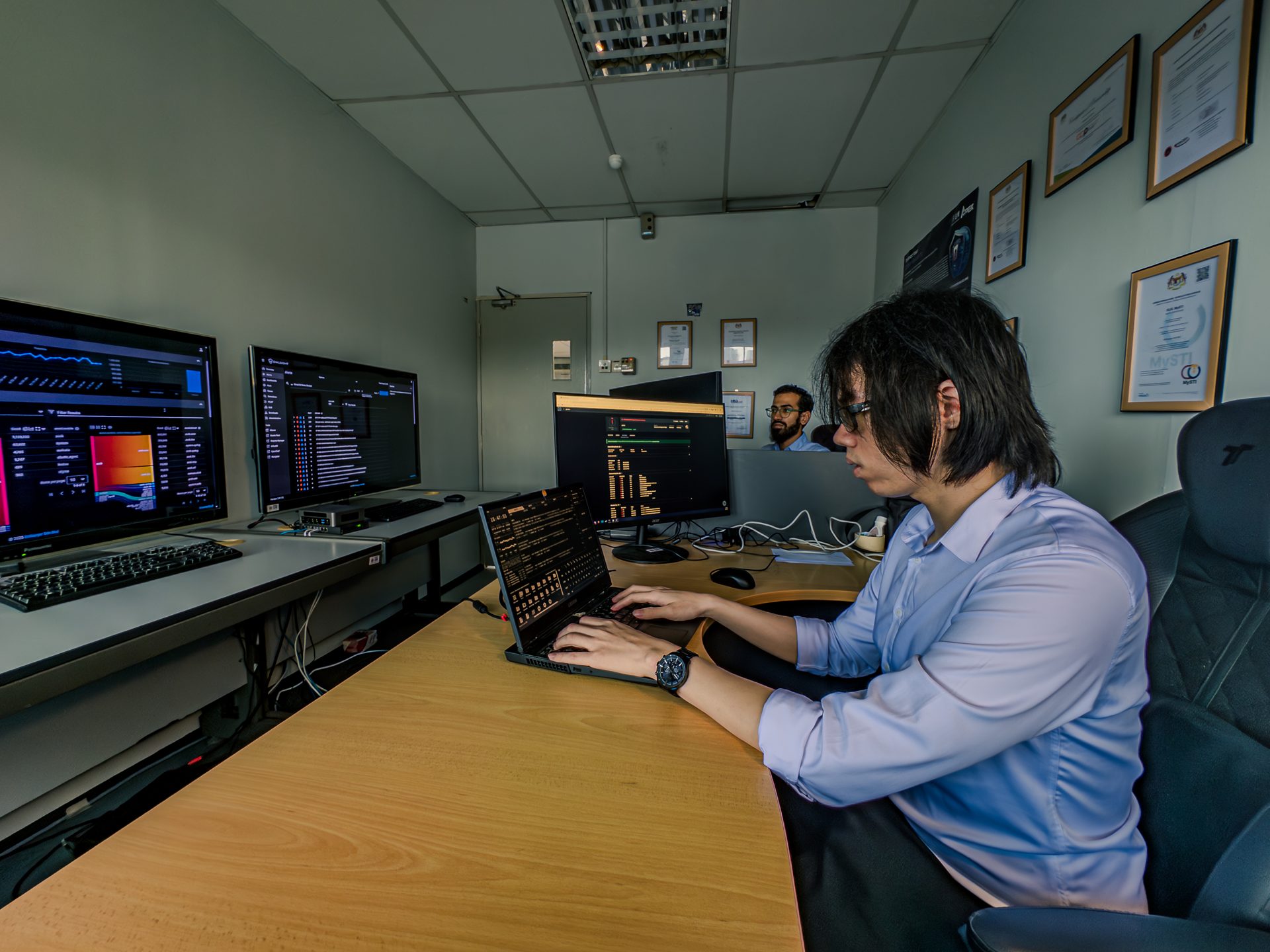
Choosing a SOC service provider in Malaysia is not simply a matter of finding a company that offers 24/7 cybersecurity monitoring.
Almost every provider can talk about security alerts, dashboards, SIEM platforms and round-the-clock monitoring. The more important question is what happens behind those words.
Will someone actually investigate suspicious activity? Can the provider understand your business environment? How quickly will your team be notified about a serious incident? Can the SOC work with your existing security tools? And does the provider understand Malaysia’s evolving cybersecurity requirements?
These questions matter because a SOC becomes part of an organisation’s security operation. Choosing the right partner can improve visibility and response, while choosing the wrong one can leave security teams dealing with the same problems they were trying to solve.
For Malaysian businesses, selecting a SOC provider should therefore involve more than comparing technology platforms or monthly costs.
Here are 10 things Malaysian businesses should consider before selecting a SOC provider.
1. Look Beyond the “24×7 SOC” Label
24×7 monitoring sounds impressive, but the number alone does not tell you how effective the service is.
Ask what actually happens when an alert is generated.
Is it automatically classified by software, or does a security analyst investigate it? How are false positives handled? What happens when a high-severity alert appears outside normal business hours?
A strong SOC should have clearly defined processes for detection, analysis, escalation and response.
The goal is not to generate more alerts. It is to identify the alerts that actually matter.
When evaluating SOC monitoring in Malaysia, businesses should understand whether the provider offers genuine continuous monitoring or simply provides access to a dashboard that generates security notifications.
The difference is important. Monitoring should ultimately help your organisation identify meaningful threats and determine what action is required.
2. Check Whether the SOC Has Human Analysts
Security technology is essential, but technology alone cannot understand every situation.
A suspicious login, unusual data transfer or unexpected administrative action may have several possible explanations. Human analysts can examine the surrounding activity and determine whether an event is likely to represent a genuine threat.
When evaluating a SOC service provider in Malaysia, ask about the role of security analysts in the monitoring process.
You should understand:
- Who investigates critical alerts?
- How are suspicious events analysed?
- How are alerts prioritised?
- When does an alert get escalated to the customer?
- Is investigation performed by people or handled primarily through automation?
Automation can help process large volumes of security data, but human investigation remains important when events require context and judgement.
A SOC should therefore combine technology with qualified security expertise rather than relying on automated alerts alone.
3. Understand What Technologies Are Supported
Your SOC provider should fit into your existing environment rather than forcing you to rebuild everything.
A typical business may have firewalls, endpoint security, cloud platforms, servers, routers, applications and identity systems from different vendors.
Before selecting a managed SOC in Malaysia, ask the provider:
- Which security technologies can be integrated?
- Can existing logs be collected?
- Does the SOC support cloud environments?
- Can endpoints and network activity be monitored together?
- How is data normalised and correlated?
- Can new technologies be added as the business grows?
A flexible SOC is more useful than one designed around a single technology stack.
Integration is particularly important for organisations that already have multiple security solutions in place. A SOC should help bring security information together so that analysts can identify relationships between events across different systems.
4. Ask How the Provider Handles False Positives
False positives are one of the biggest operational challenges for security teams.
If every unusual event becomes a high-priority alert, the security team can quickly become overwhelmed.
A good SOC should continuously improve its detection logic based on the organisation’s environment.
For example, a specific administrative action may be normal for one employee but unusual for another. Context helps determine the difference.
The provider should therefore have a process for tuning detections and reducing unnecessary alerts over time.
When comparing SOC services in Malaysia, ask how the provider measures alert quality and how often detection rules are reviewed.
The objective should not simply be to detect more events. It should be to improve the quality and relevance of security alerts so that your internal team can focus on genuine risks.
5. Look at the Quality of Reporting
A SOC should not simply send hundreds of technical alerts to your IT team.
Reporting should help decision-makers understand what is happening.
A useful report might show:
- Important security events
- Detected threats
- Affected assets
- Severity and business impact
- Investigation status
- Recommended actions
- Recurring security patterns
- Trends over time
Technical teams need enough detail to investigate an event, while management needs a clear view of risk and priorities.
The best SOC reporting serves both audiences.
Before selecting a SOC provider in Malaysia, ask to see an example of the reporting you will receive. This can help you understand whether the provider communicates meaningful security information or simply provides technical data without sufficient context.
6. Ask What Happens During a Real Incident
This is one of the most important questions to ask before signing a contract.
Imagine your organisation experiences a suspected ransomware incident at 2 a.m.
Who contacts you?
What information will you receive?
Who decides whether the affected system should be isolated?
Will the SOC support the investigation?
Can evidence be preserved for further analysis?
A SOC provider should have a clearly documented escalation process. The roles and responsibilities between the provider and customer should be understood before an incident occurs.
Malaysia’s Cyber Security Act 2024 also places greater emphasis on the management of cybersecurity threats and incidents for National Critical Information Infrastructure entities. NACSA maintains specific incident reporting mechanisms and guidance for cyber incidents.
This makes incident preparedness an important consideration when assessing a Security Operations Centre in Malaysia.
A provider should be able to explain what happens from the moment a potentially serious event is detected through investigation, escalation and customer notification.
7. Consider Malaysian Cybersecurity Requirements
Local regulatory awareness can be important when choosing a SOC provider.
Malaysia’s Cyber Security Act 2024 came into operation on 26 August 2024 and introduced provisions covering cybersecurity threats and incidents affecting NCII, along with licensing of certain cybersecurity service providers.
The Schedule to the Act lists 11 NCII sectors:
- Government
- Banking and finance
- Transportation
- Defence and national security
- Information, communication and digital
- Healthcare services
- Water, sewerage and waste management
- Energy
- Agriculture and plantation
- Trade, industry and economy
- Science, technology and innovation
Not every business falls under the same requirements, but organisations should understand whether their industry has specific obligations.
When comparing SOC service providers in Malaysia, ask whether they understand the relevant Malaysian cybersecurity landscape and can support your organisation’s governance requirements.
Regulatory considerations should form part of the evaluation process rather than being treated as an afterthought.
For businesses operating in regulated industries, local cybersecurity expertise can also make it easier to understand how monitoring, incident management and reporting fit into broader security and compliance processes.
8. Check How Your Data Is Handled
Security monitoring involves sensitive information.
Logs can contain details about users, devices, applications, network activity and internal systems.
Before choosing a SOC, ask:
- Where is security data processed?
- Where are logs stored?
- Who can access the information?
- How long is data retained?
- How is information protected?
- Can sensitive raw logs remain within your environment?
- What security controls protect the SOC infrastructure?
Data handling should be clearly documented rather than treated as a minor technical detail.
Businesses should understand how their security information moves between their environment and the SOC, who can access it, and what controls are in place to protect it.
This is particularly important when evaluating external managed SOC services, because the provider becomes part of the organisation’s wider security ecosystem.
9. Look for Threat Intelligence Integration
A SOC should not operate in isolation from the wider threat landscape.
Threat intelligence can provide additional context around suspicious domains, IP addresses, malware indicators, attacker techniques and active campaigns.
For example, an unusual connection from an employee workstation may initially look like a low-priority event.
If the destination is associated with an active attack campaign, the significance changes.
Threat intelligence helps analysts connect individual events with broader patterns.
This can improve detection, investigation and prioritisation.
When assessing SOC monitoring services in Malaysia, ask how threat intelligence is incorporated into the monitoring and investigation process.
The ability to combine security events with relevant threat information can help analysts distinguish between routine activity and activity that may indicate a wider attack.
10. Evaluate the Provider’s Security Expertise
Technology can be compared relatively easily.
Experience is harder to measure.
Ask about the team’s expertise, certifications, security processes and experience with organisations similar to yours.
You should also ask whether the provider can support you as your environment changes.
Your organisation may move more applications to the cloud, introduce new endpoints, expand into new locations or adopt new technologies.
Your SOC provider should be capable of adapting with you.
A good SOC service provider in Malaysia should be able to understand your environment, identify relevant risks and continuously adapt its monitoring approach as your organisation evolves.
The right partner should feel like an extension of your security team rather than simply another technology vendor.
Questions to Ask a SOC Provider Before Signing
Before making a decision, businesses can use a simple checklist:
Who investigates alerts?
Understand whether alerts are reviewed by security analysts or handled primarily through automated processes.
What happens when a critical threat is detected?
Ask for the actual escalation workflow.
Can you integrate with our current security tools?
Your provider should be able to work with your existing infrastructure wherever possible.
How do you reduce false positives?
A good provider should have a clear process for detection tuning.
How do you protect our security data?
Understand storage, access, retention and processing practices.
What reporting will we receive?
Ask to see a sample report before committing.
How do you support incident response?
Make sure responsibilities are clearly defined between your team and the SOC.
Can the service scale with our organisation?
Your security monitoring requirements will probably change as your business grows.
These questions can help businesses compare SOC providers in Malaysia based on actual service capabilities rather than marketing claims.
Why the Right SOC Partner Matters
A SOC is not just another cybersecurity product.
It becomes part of the organisation’s security workflow.
The provider receives security information from your environment, analyses potential threats and communicates with your team when action may be required. That makes trust, communication and technical capability just as important as the monitoring platform itself.
For Malaysian businesses, the decision is even more relevant as the country’s cybersecurity framework continues to develop. NACSA’s current resources include the Cyber Security Act 2024, licensing regulations for cybersecurity service providers, national cybersecurity baselines and guidance related to cyber risk and incident management.
The right SOC provider should therefore offer more than a dashboard.
It should provide useful security insight, meaningful analysis and a clear path from detection to action.
This is where the difference between simply having security monitoring and having a managed security operations capability becomes important.
A provider that combines continuous monitoring, local cybersecurity knowledge and human-led investigation can help organisations build a more structured approach to detecting and responding to threats.
Frequently Asked QuestionsWhat is a SOC service provider?
A SOC service provider delivers security operations capabilities such as continuous monitoring, threat detection, alert investigation and security analysis. Depending on the service, the provider may also support incident response and threat intelligence.
How much does a SOC service cost in Malaysia?
SOC services are usually priced on the size of the environment being monitored. BitRanger prices OwlSight on the number of assets, or the events per second, in your organisation, so we first hold a session to understand your requirements before giving you a quote. Reach out for an initial discussion, and we will work out the solution and pricing with you from there.
What should I look for in a SOC service provider in Malaysia?
Look for experienced analysts, strong detection capabilities, integration with existing security technologies, clear escalation procedures, useful reporting, appropriate data protection and knowledge of Malaysia’s cybersecurity requirements.
Is a managed SOC suitable for SMEs?
Yes. A managed SOC can give SMEs access to security monitoring and specialist expertise without requiring them to build a complete security operations team internally.
Does a SOC replace antivirus or endpoint security?
No. A SOC works alongside endpoint security, firewalls, identity controls and other cybersecurity technologies. It provides monitoring, analysis and security operations capabilities across these technologies.
Does a SOC provider need a licence in Malaysia?
Yes, for prescribed services. Section 27 of the Cyber Security Act 2024 says no one may provide or advertise a prescribed cyber security service without a NACSA licence. Managed security operation centre monitoring is one of the prescribed services, so ask to see your provider’s licence.
Can a SOC monitor cloud environments?
Yes. Modern SOC services can monitor security events from cloud platforms alongside traditional on-premises infrastructure, provided the required integrations and data sources are available.
How is a SOC different from penetration testing?
Penetration testing is designed to simulate attacks and identify exploitable weaknesses. A SOC focuses on ongoing security monitoring and detection. The two services address different parts of an organisation’s security strategy.
Final Thoughts
Choosing a SOC service provider in Malaysia should not come down to who offers the longest list of security tools or the lowest monthly price.
The better question is whether the provider can help your organisation understand what is happening across its digital environment, investigate suspicious activity and act when something looks wrong.
Look at the people behind the technology, the quality of detection, the incident escalation process, data handling practices, reporting capabilities and understanding of the Malaysian cybersecurity environment.
A good SOC should make security operations clearer, not more complicated.
For organisations that want to improve their security maturity, selecting the right SOC partner can be an important step toward building a more proactive and better-managed cybersecurity programme.
See How BitRanger OwlSight Can Support Your Security Operations
BitRanger OwlSight SOC is built around these exact principles: local 24/7 monitoring, NACSA-licensed compliance support, and human-analyst investigation behind every alert.
If you are evaluating SOC services in Malaysia or looking to strengthen your existing security operations, get in touch with BitRanger to see how OwlSight fits into your environment.